
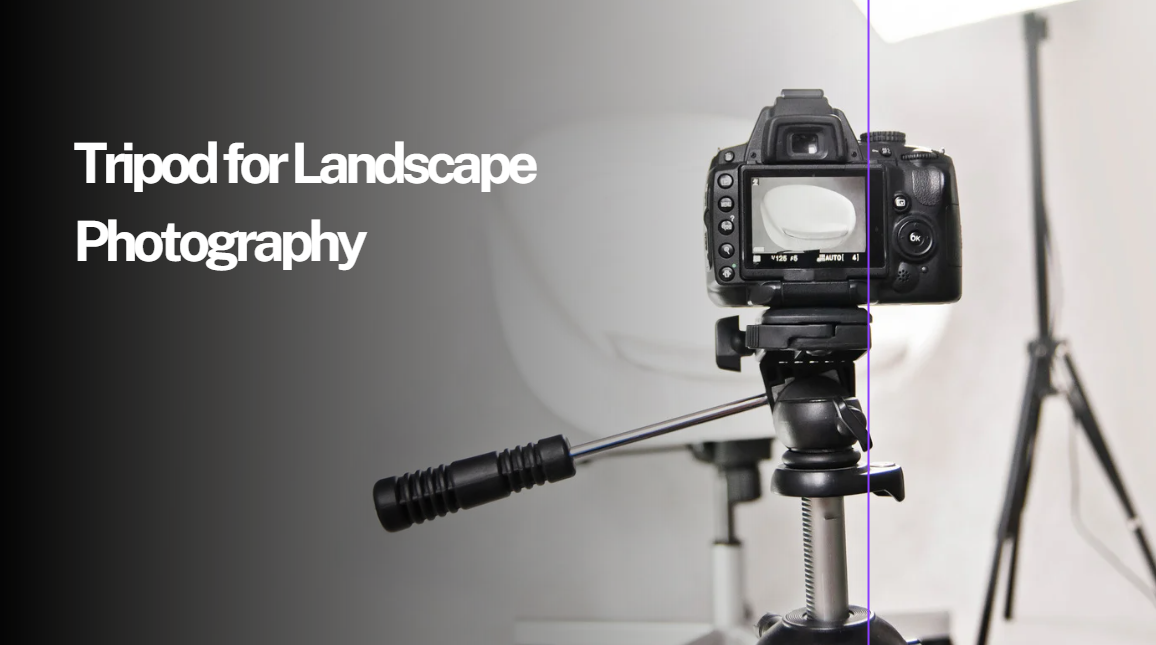
Tripod for Landscape Photography Landscape photography is all about beautiful views, natural light, strong composition, and sharp details. A good camera and lens are important, but a tripod can make a major difference when you want to create clear and steady landscape images.
A tripod for landscape photography gives your camera a stable base. This is especially useful when photographing waterfalls, rivers, clouds, mountains, forests, beaches, and night landscapes.
Instead of quickly holding your camera and taking a picture, you can carefully position the frame, check the horizon, adjust the exposure, and wait for the right light.
Modern landscape tripods come in many sizes and materials. Carbon fiber models are popular because they can offer a useful balance between low weight and stability, while aluminum tripods are often less expensive. Current 2026 tripod guides continue to emphasize that weight, leg design, working height, head quality, and stability all matter when choosing a landscape tripod.
This guide explains everything beginners and experienced photographers should know before choosing a tripod for landscape photography.
Why Do You Need a Tripod for Landscape Photography?
A tripod keeps your camera steady during the photograph.
When you take a picture by hand, your hands naturally move slightly. At fast shutter speeds, this movement may not be noticeable. However, when you use a slow shutter speed, even a small movement can make the photograph look soft.
Landscape photographers often use slow shutter speeds for creative effects. A tripod makes these techniques much easier.
A tripod is also useful when the photographer wants to keep the camera in exactly the same position for several photographs. This can help with panoramas, exposure bracketing, focus stacking, and other techniques.
Also Read : Shoes for Men LV
Best Tripod for Landscape Photography
There is no single tripod that is perfect for every photographer.
The best tripod depends on your camera, lens, travel style, budget, and the places where you take photographs.
A lightweight carbon fiber tripod can be a good choice for photographers who hike long distances. A larger tripod may be better for photographers who work in windy locations or use heavy camera equipment.
The Peak Design Travel Tripod, Manfrotto carbon fiber models, Benro Tortoise systems, and larger Gitzo tripods are examples of different approaches to landscape support. Current landscape tripod guides show that compact travel designs and larger professional systems can both be useful depending on the photographer’s needs.
The most important thing is not simply buying the biggest tripod. You need a tripod that you will actually carry and use.
Also Read : Photography ISO Settings
Carbon Fiber vs Aluminum Tripod
The material used to make the tripod can affect its weight, feel, durability, and price.
Carbon fiber tripods are popular among landscape photographers because they can be lighter than comparable aluminum models while offering strong stiffness and vibration control. Current tripod guides commonly describe carbon fiber as a useful choice for photographers who need to carry their equipment over long distances.
Aluminum tripods are usually less expensive. They can also be very stable, especially when using a larger and heavier model.
For a photographer who mostly works close to the car, an aluminum tripod may provide excellent value.
For a photographer who regularly climbs mountains or walks several kilometers to reach a location, reducing tripod weight can be much more important.
Also Read : photography emblem
Why Carbon Fiber Is Popular for Landscape Photography
Landscape photography often involves hiking.
You may need to walk through forests, climb hills, cross rocky ground, or travel to remote locations. Carrying a heavy camera bag for several hours can become tiring.
Carbon fiber can reduce the weight of the tripod without making it extremely weak. This makes it attractive for outdoor photography.
Carbon fiber is also resistant to corrosion, which can be useful around water and coastal environments. However, the locks, joints, and other metal parts still need proper care after exposure to salt water, sand, or dirt.
The main disadvantage is price. Carbon fiber tripods generally cost more than similar aluminum models.
Tripod Size and Height
Tripod height is another important feature.
A tripod that is too short can force you to bend down constantly. A tripod that is extremely tall may be heavier and less convenient to carry.
For landscape photography, look for a tripod that can provide a comfortable working height while also allowing you to shoot close to the ground.
Low-angle photography is very useful for landscapes. You may want to place the camera close to flowers, rocks, grass, sand, ice, or water to create a strong foreground.
A tripod with a wide leg angle can make low shooting much easier.
Minimum Height Matters
Many beginners only check the maximum height of a tripod.
The minimum height is also important.
Imagine photographing a small stream flowing between rocks. A very low camera position can make the foreground look larger and more interesting.
A tripod that can spread its legs wide and sit close to the ground gives you more creative options.
Some landscape tripods can be used only a few inches above the ground, while travel models may offer a more limited range.
Think about the type of compositions you enjoy before choosing.
Center Column and Landscape Photography
Many tripods have a center column that allows the camera to be raised higher.
A center column is useful when you need extra height. However, extending it completely can reduce stability because the camera sits farther away from the main tripod structure.
For long exposures, photographers often prefer to keep the center column low or avoid extending it when possible.
Some professional landscape tripods are designed without a traditional center column. This keeps the camera closer to the leg platform and can provide a more stable setup.
A center column is not automatically bad.
Tripod Leg Sections
Tripod legs can have different numbers of sections.
A tripod with more sections can fold into a smaller package. This is useful for travel.
However, additional sections can mean thinner lower leg tubes and more joints.
A tripod with fewer sections may be quicker to set up and can feel more rigid, but it may be longer when folded.
Landscape photographers should balance portability and stability.
If you work near your vehicle, a larger tripod may make more sense.
Twist Locks vs Flip Locks
Twist locks are rotated to unlock and lock each section.
Flip locks use small levers that open and close.
Both systems can work well.
Flip locks can be quick to operate, especially when you need to set up quickly.
Twist locks can have a cleaner shape and are often preferred by photographers who want a compact design.
Your personal preference matters. If possible, try both types before making a purchase.
Choosing the Right Tripod Head
The head connects your camera to the tripod and controls how you position it.
A poor tripod head can make a good set of legs frustrating to use.
Landscape photographers commonly use ball heads, three-way heads, geared heads, and panoramic or leveling systems.
Ball heads are popular because they are compact and allow fast adjustments.
Three-way heads give more independent control over horizontal, vertical, and tilt movements.
Geared heads can provide very precise adjustments and are useful when exact framing is important.
For most general landscape photography, a good ball head can provide a simple balance between speed and control.
What Makes a Good Ball Head?
A good ball head should move smoothly and lock firmly.
When you position a heavy camera and lens, the head should not slowly move downward after you tighten it.
A separate panning control is also useful for panoramas.
A compatible quick-release plate can make it much easier to attach and remove the camera.
Many photographers use an L-bracket because it makes it easier to switch between horizontal and vertical compositions while keeping the camera centered over the tripod.
Tripod Load Capacity
Every tripod has a maximum load rating.
This number tells you approximately how much equipment the manufacturer says the tripod can support.
However, do not choose a tripod based only on the largest number printed on the specifications.
Different manufacturers measure load capacity differently. A tripod that can technically hold a heavy camera may not provide enough rigidity for a very long exposure in strong wind.
Think about your complete setup.
Include the camera body, lens, filters, flash if attached, and other equipment mounted on the tripod.
Tripod Stability in Wind
Wind is one of the biggest challenges for landscape photographers.
A lightweight tripod may be easy to carry, but strong wind can cause movement.
Avoid extending the center column unnecessarily.
Make sure all leg locks are firmly secured.
You can also position the tripod so that the camera and lens are protected from direct wind.
A heavy tripod can help, but simply hanging a heavy camera bag from the center column is not always the best solution. If the bag swings in the wind, it can actually introduce movement.
A stable ground position is usually more important.
Using a Tripod for Long Exposure Photography
Long exposure is one of the biggest reasons landscape photographers use tripods.
You can slow the shutter speed to create smooth water, moving clouds, light trails, and other effects.
For example, a waterfall photographed at a fast shutter speed may show individual drops of water. With a slower shutter speed, the moving water can appear soft and smooth.
A tripod keeps the camera still while the subject moves.
This reduces movement caused by pressing the shutter button.
Image stabilization can also affect tripod shooting. Depending on the camera and lens, stabilization may need to be turned off when the camera is firmly mounted, although some modern systems can detect tripod use automatically.
Always check your camera and lens instructions.
Tripod for Waterfall Photography
Waterfalls are excellent subjects for tripod photography.
A tripod allows you to use slower shutter speeds while keeping rocks and other stationary objects sharp.
You can experiment with different shutter speeds to create different water effects.
Do not put your tripod directly in dangerous or fast-moving water.
Wet rocks can be slippery, and changing water levels can create serious risks.
A tripod with strong leg locks and good footing can be especially useful around streams and waterfalls.
Tripod for Sunrise and Sunset Photography
Sunrise and sunset are popular times for landscape photography.
Light changes quickly during these periods.
A tripod allows you to set your composition before the light becomes perfect.
You can carefully adjust the camera, attach filters, check the horizon, and wait for the right moment.
Make sure you arrive early enough to set up safely.
Tripod for Night Landscape Photography
This is useful for photographing stars, the Milky Way, moonlit landscapes, and night scenes.
For astrophotography, stability is especially important.
Use a stable tripod, avoid touching the camera during the exposure, and check the focus carefully.
Tripod for Panorama Photography
A tripod can make panoramic photography easier.
When creating a panorama, you take several photographs and combine them later.
Keeping the camera level can make the stitching process easier.
For more advanced panoramas, photographers may use leveling bases and nodal rails to reduce alignment and parallax problems. A tripod alone does not guarantee a perfect panorama, but it provides a stable foundation.
Lightweight Tripod for Hiking
If you hike with your camera, weight becomes extremely important.
A tripod that is technically excellent but too heavy may remain at home.
Modern travel tripods can fold into relatively small packages while still providing useful stability. Some current models weigh around three pounds, making them easier to carry during longer walks.
The tradeoff is that very small tripods may not be as stable as large professional models.
Choose based on where you actually photograph.
Best Budget Tripod for Landscape Photography
Beginners do not need to spend a huge amount of money.
A good aluminum tripod from a reliable manufacturer can be enough to learn landscape photography.
The important thing is to avoid extremely weak tripods that flex easily or have unstable heads.
A cheap tripod that moves whenever you touch the camera can become frustrating very quickly.
Instead of buying the cheapest model available, look for a tripod with strong leg locks, a stable base, a useful height range, and a head that locks securely.
As your photography improves, you can upgrade later.
How to Set Up a Tripod Correctly
Setting up the tripod correctly is just as important as buying a good one.
Place the tripod on stable ground.
Spread the legs evenly.
Keep the center column low.
Make sure every leg lock is secure.
Attach the camera carefully.
Check the horizon and composition.
Before taking a long exposure, make sure the tripod is not standing on loose ground that could move.
Small setup mistakes can reduce the benefits of an expensive tripod.
Common Tripod Mistakes
One common mistake is extending the center column completely.
Another is using a tripod that is too lightweight for the camera and lens.
Some photographers also fail to tighten the leg locks properly.
Another mistake is placing the tripod on unstable ground.
Using a cheap or weak tripod head can also create problems.
Some photographers carry a tripod everywhere but never actually use it.
How to Protect Your Tripod Outdoors
Landscape photography can expose equipment to rain, mud, sand, dust, salt water, and cold weather.
Clean the legs after shooting in dirty conditions.
If you photograph near the ocean, rinse the tripod with fresh water after exposure to salt spray, following the manufacturer’s care instructions.
Check the leg locks regularly.
Remove sand and dirt from moving parts carefully.
Do not force a lock if it becomes difficult to turn.
Proper maintenance can help a tripod last for many years.
Final Thoughts on a Tripod for Landscape Photography
A tripod is one of the most useful pieces of equipment for serious landscape photography.
It provides stability for long exposures, helps with careful composition, supports panoramic photography, and makes it easier to work in low light.
The best tripod is not necessarily the heaviest or most expensive one.
If you hike often, a lightweight carbon fiber tripod may be the right choice.
Pay attention to tripod height, minimum shooting position, leg sections, locking system, center column design, load capacity, and tripod head quality.
Also think about your camera and lens. A small mirrorless camera does not need the same support as a large professional body with a heavy telephoto lens.
Most importantly, choose a tripod that you will actually carry into the field.
A stable camera gives you more freedom to slow down, study the scene, wait for beautiful light, and create the photograph you want.
FAQs
What is the best tripod for landscape photography?
The best tripod depends on your camera, lens, budget, and travel needs.
Do I really need a tripod for landscape photography?
You can take landscape photographs handheld, especially in bright light and with fast shutter speeds. However, a tripod becomes very useful for long exposures, low-light scenes, panoramas, waterfalls, and careful compositions.
What height should a landscape tripod be?
A tripod should be tall enough for comfortable shooting but also capable of getting low to the ground. A useful height range gives you more creative choices.
Is a travel tripod good for landscape photography?
Yes. A travel tripod can be a good option for hikers and photographers who value portability. The main tradeoff is that compact tripods may provide less stability than larger models.
What tripod head is best for landscape photography?
A good ball head is a popular choice because it is compact and quick to adjust. Three-way and geared heads can provide more precise independent control.
Should I turn off image stabilization when using a tripod?
It depends on your camera and lens. Some systems recommend turning stabilization off when mounted on a tripod, while newer systems may automatically detect tripod use. Check the instructions for your specific camera and lens.